A Peasant
R.S. Thomas's 'A Peasant' is a powerful, unsentimental portrait of a Welsh hill farmer that subverts traditional romantic views of the countryside. Studying this poem allows candidates to explore profound themes of human endurance, class prejudice, and the unbreakable bond between identity and landscape, offering rich opportunities for high-level language and structural analysis.
Study Notes
Overview
'A Peasant', published in 1942, introduces Iago Prytherch, a recurring figure in R.S. Thomas's poetry who serves as a symbol of the rural Welsh hill farmer. The poem is a deliberate subversion of the pastoral tradition; rather than presenting a romanticised, idyllic view of country life, Thomas offers a stark, unflinching portrait of gruelling physical labour. For examiners, this poem is an excellent vehicle for testing AO2 (analysis of writer's methods), as Thomas uses a complex mix of harsh imagery, military metaphors, and a shifting narrative perspective to elevate an 'ordinary' man to heroic status. Top-tier responses will recognise the speaker's ambivalence—the mixture of repulsion and profound respect—and explore how the poem critiques the condescension of the 'refined' urban classes towards rural workers.
Plot/Content Overview
The poem consists of a single, unbroken 22-line stanza. It begins by introducing Iago Prytherch by name, describing his harsh daily routine of tending sheep and working the unforgiving Welsh earth. The speaker observes his 'half-witted grin' and the rarity of his joy, which is compared to the infrequent appearance of the sun in the harsh climate. The poem then shifts to a nighttime scene, where Iago sits motionless by the fire, his mind seemingly vacant and his clothes smelling of sweat and animals—a reality that shocks 'refined' observers. However, in the final movement (line 17 onwards), the speaker directly addresses the reader, declaring Iago as 'your prototype'. The poem concludes by elevating Iago, describing him through military metaphors as an 'impregnable fortress' and a 'winner of wars' who endures timelessly like a tree under the stars.
Themes
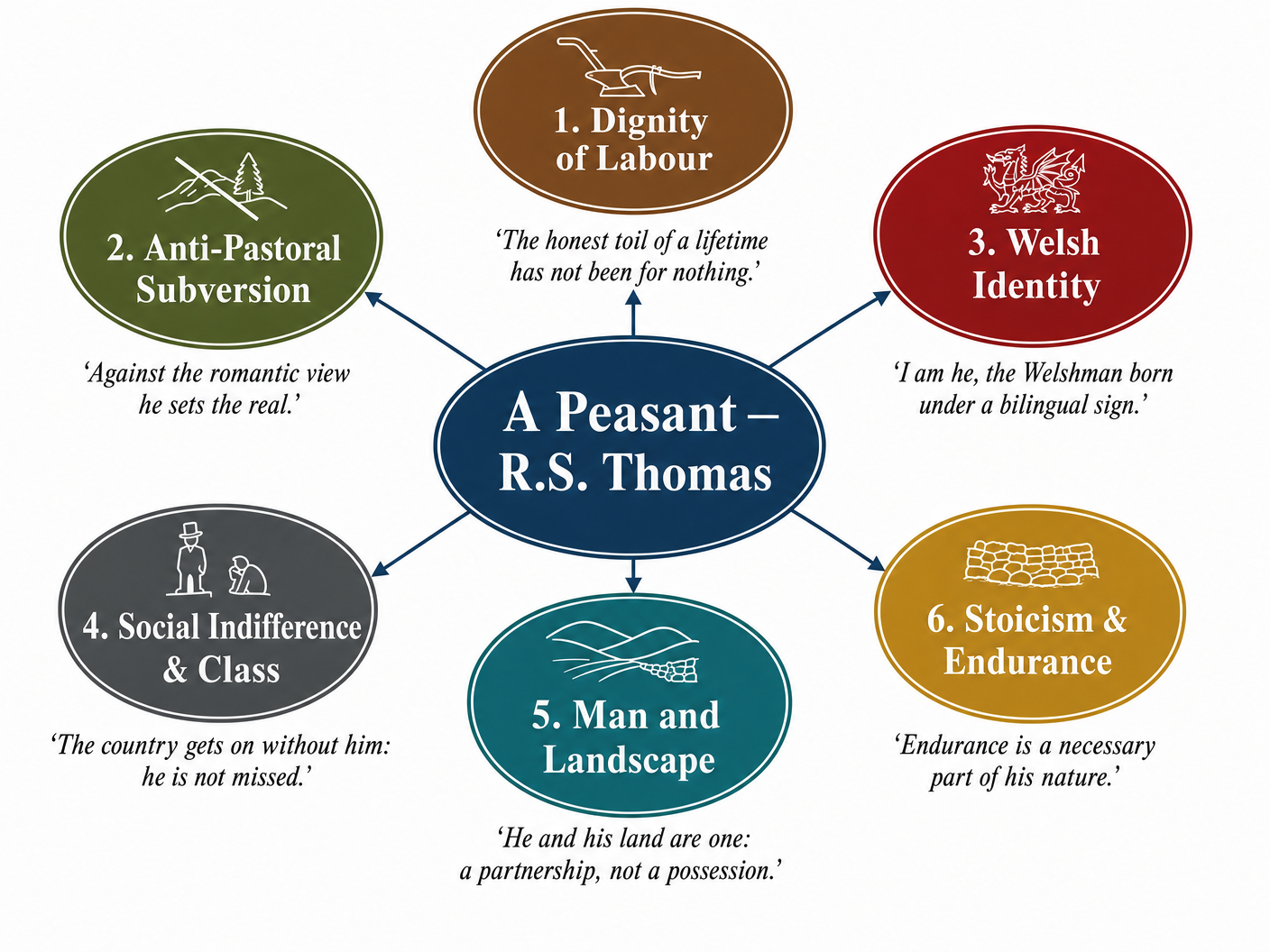
Theme 1: The Dignity of Labour and Human Endurance
Thomas challenges the notion that physical, agricultural labour is degrading. While he does not shy away from the brutal reality of the work ('churning the crude earth'), he ultimately frames this endurance as a form of heroism. Iago's ability to survive the harsh conditions is presented as a profound achievement.
Key Quotes:
- "Just an ordinary man of the bald Welsh hills" - The word 'just' is subversive; Thomas starts by diminishing Iago only to elevate him by the poem's end. The 'bald' hills strip away romantic illusions.
- "Preserves his stock, an impregnable fortress" - The use of military metaphor elevates the peasant's daily struggle to the status of a heroic siege, suggesting his resilience cannot be defeated.
- "Remember him, then, for he, too, is a winner of wars" - The imperative 'Remember him' demands respect, placing the peasant's quiet endurance on par with celebrated military victories.
Theme 2: Anti-Pastoral Subversion
Unlike Romantic poets (like Wordsworth or Keats) who often depicted the countryside as a place of spiritual renewal and gentle beauty, Thomas presents an 'anti-pastoral' vision. The landscape is hostile, and the work is monotonous and physically degrading.
Key Quotes:
- "his spittled mirth / Rarer than the sun that cracks the cheeks / Of the gaunt sky" - The harsh sibilance and the personification of the sky as 'gaunt' with cracked cheeks emphasise the brutal, unforgiving nature of the environment.
- "sour with years of sweat / And animal contact" - This visceral, olfactory imagery deliberately repels the reader, refusing to sanitise the reality of agricultural life.
Theme 3: Social Indifference and Class Prejudice
The poem acts as a sharp critique of the urban middle classes (the 'refined') who look down upon rural workers. Thomas suggests that this refinement is superficial and lacks the profound, rooted authenticity of the peasant.
Key Quotes:
- "shock the refined, / But affected sense with their stark naturalness" - The juxtaposition between the 'refined' (who are actually 'affected' or artificial) and Iago's 'stark naturalness' exposes the hypocrisy of class prejudice.
- "There is something frightening in the vacancy of his mind" - This reflects the educated observer's fear of what they do not understand; they misinterpret Iago's stoic silence as ignorance.
Character Analysis
Iago Prytherch
Role: He serves as the archetypal Welsh hill farmer, a symbol of a vanishing way of life and a mirror reflecting the prejudices of the observer.
Key Traits: Stoic, enduring, physically hardened, deeply connected to the landscape, unrefined but authentic.
Character Arc: He does not change within the poem; rather, the reader's perception of him is forced to change, moving from viewing him as a 'half-witted' labourer to a heroic 'prototype'.
Essential Quotes:
- "Iago Prytherch his name" - Grounding him in specific Welsh identity.
- "Enduring like a tree under the curious stars" - Connecting him permanently to the natural, cosmic order.
Writer's Methods
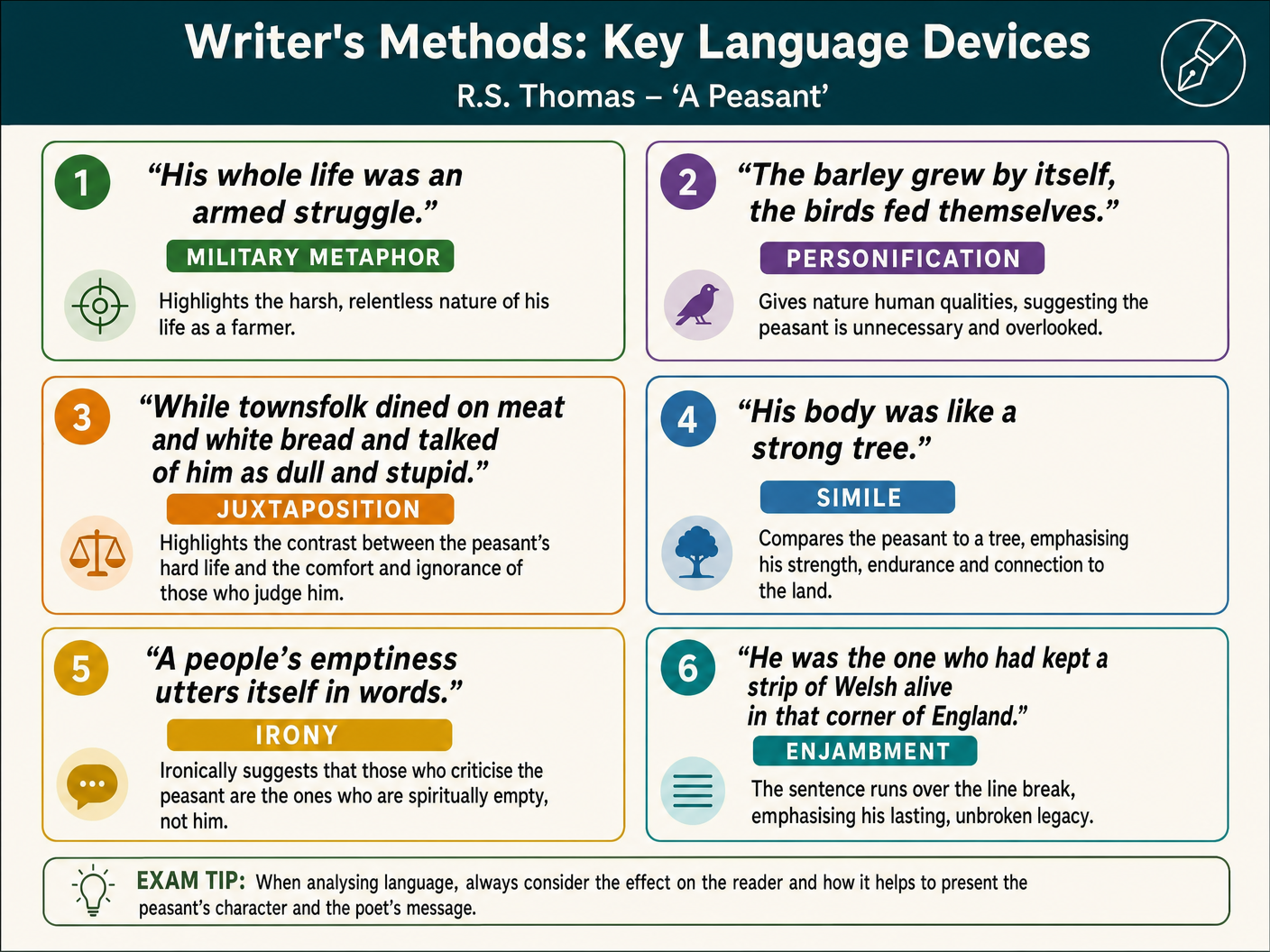
Thomas's methods are characterised by a deliberate tension between harsh realism and elevated rhetoric.
Structure and Form: The poem is written in a single, unbroken stanza. This visual block of text on the page mirrors the relentless, unceasing nature of Iago's labour. The heavy use of enjambment (e.g., 'chipping the green skin / From the yellow bones') propels the reader forward, mimicking the continuous physical effort. The rhyme scheme is irregular, reflecting the rough, unpredictable nature of rural life, but Thomas uses rhyming couplets at key moments (e.g., the final lines 'wars / stars') to provide a sense of resolution and to elevate the subject matter.
Perspective Shift: A crucial structural device occurs at line 17: "Yet this is your prototype". The poem shifts from a third-person observation ('he') to a direct second-person address ('your'). This volta (turning point) breaks the distance between the observer and the subject, implicating the reader and forcing them to acknowledge their connection to this foundational figure.
Imagery and Metaphor: Thomas employs visceral, unglamorous imagery ('gob in the fire', 'spittled mirth') to subvert pastoral expectations. However, in the final movement, he shifts to grand military metaphors ('siege of rain', 'wind's attrition', 'impregnable fortress'). This semantic field of warfare completely reframes Iago's existence, transforming mere survival into a heroic victory.
Context
Understanding R.S. Thomas's context is vital for top-band AO3 marks. Thomas was an Anglican priest who served in rural Welsh parishes. He was highly educated, English-speaking by upbringing, but a passionate Welsh nationalist who learned Welsh later in life. This created a complex dynamic: he was an outsider looking in at his own parishioners. His poetry often reflects this tension—a mixture of intellectual distance, repulsion at the harshness of their lives, and profound respect for their endurance. Written in 1942, during the Second World War, the poem's military metaphors ('winner of wars') take on added significance, suggesting that the quiet survival of the rural worker is as vital and heroic as the battles fought by soldiers.
Visual Resources
2 diagrams and illustrations
Interactive Diagrams
1 interactive diagram to visualise key concepts
Conceptual Flow Outline
The structural and thematic progression of 'A Peasant'
Worked Examples
1 detailed example with solutions and examiner commentary
Practice Questions
Test your understanding — click to reveal model answers
Starting with the lines 'Yet this is your prototype...' to the end of the poem, explore how Thomas presents the idea of endurance. Write about:
- how endurance is presented in these lines
- how endurance is presented in the poem as a whole (30 marks)
Hint: Look closely at the military metaphors in the final lines. How do they change our view of the peasant's daily struggles described earlier in the poem?